

About stainless steel
A second material to know, after brass. If you missed the first article, here is the link: brass.
Today, I'm going to tell you about stainless steel.
What is stainless steel?
Stainless steel is an alloy of iron, chromium, carbon...
This metal is very strong and very resistant. It is also hypoallergenic.

Advantages of stainless steel:
- It is hot malleable and can be engraved.
- It is hypoallergenic. It does not cause skin reactions except in very rare cases.
- It is eco-friendly. Its environmental impact is low, as it does not release nickel and can be recycled indefinitely...
- It is virtually indestructible and undeformable.
- It requires little maintenance.

201 stainless steel, 304 stainless steel, 316 stainless steel: what are the differences?
201 stainless steel:
Advantages: Less expensive than 304 or 316 steel; nickel allergy sufferers can wear it; easy to clean.
Disadvantages: less corrosion resistance because it contains less chromium; it has a darker appearance because it contains about 7% manganese; it tends to rust.
304 stainless steel:
Advantages: it is the most common form of stainless steel; heat resistant; easy to clean; it contains less chromium than 316 steel and is very versatile.
Disadvantages: it is more susceptible to corrosion from saline environments (e.g., sea salt water) than 316 stainless steel.
316 stainless steel:
Advantages: thanks to the 2 to 3% molybdenum content, it is more resistant to corrosion in chlorinated, iodized or polluted atmospheres; second most common form for this metal; much stronger, very good resistance to high temperatures; 316L stainless steel (L= low carbon) can be used for piercings after healing.
Disadvantages: more expensive than 201 or 304 steel; it contains more nickel than 304 steel.
What colors?
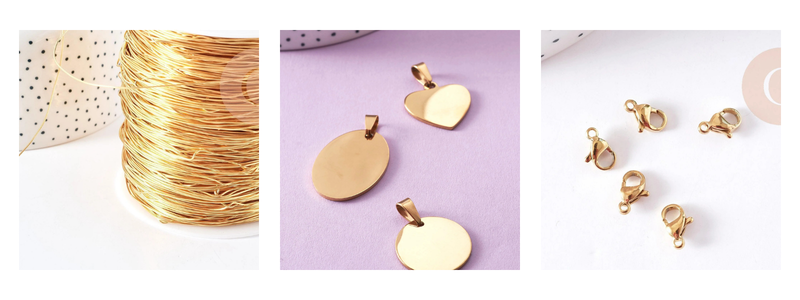
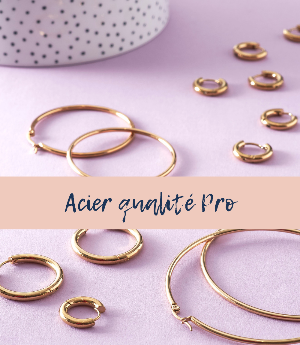
Steel can come in three colors: silver, gold, and rose copper.
Does steel move, rust?
Jewelry-grade steel does not deteriorate over time, so it will not rust or change color. Your jewelry will last!
A test to check its quality:
Stainless steel jewelry is magnetic.
If your jewelry does not stick or sticks weakly, it is probably an imitation or an aluminum product.
However, steel jewelry may be less sensitive to magnets; this means that their alloy is low in chromium and carbon.
Tip: if the jewelry rusts after a week when you run it under water, it is not steel.

I hope I've taught you something. I wish you a great day and see you soon for a new tutorial